Storage Industry Research
West Ox Advisors diagnoses the magnetic data storage industry's chronic underinvestment in breakthrough technology, even at record profitability, explains why concentrated markets produce exactly this result, and proposes the institution the industry never built to fix it.



Publications
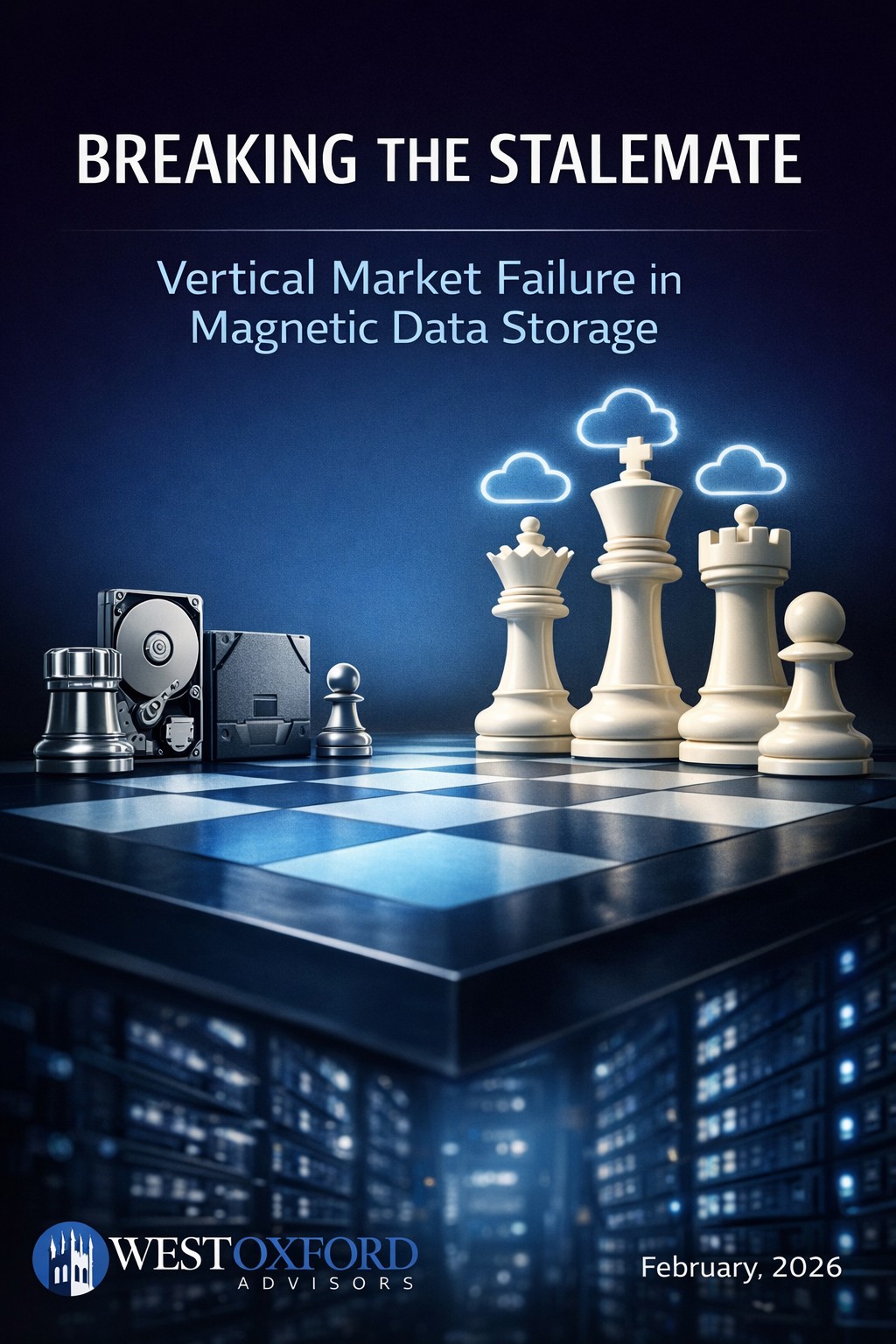
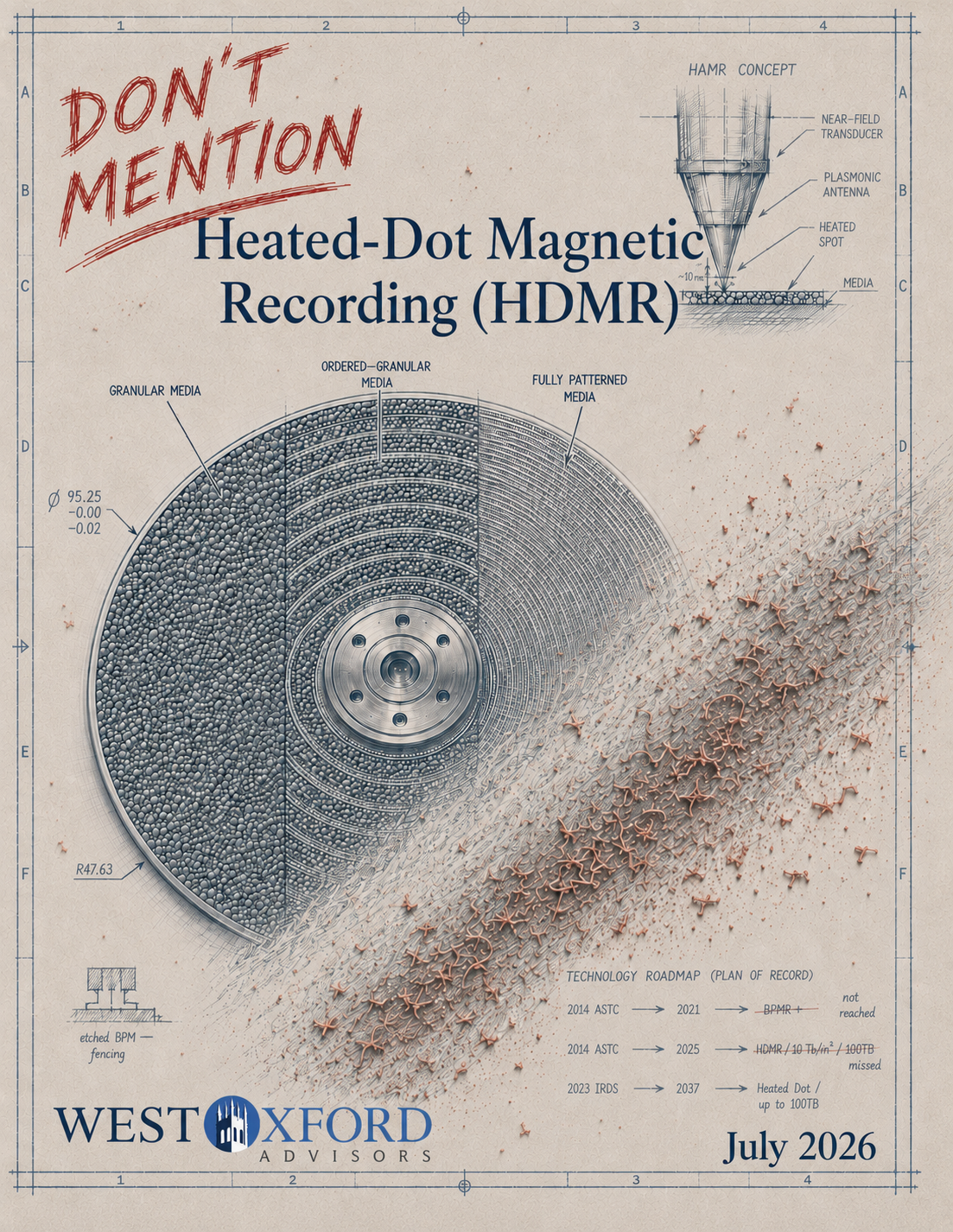
Breaking the Stalemate diagnoses the dynamic: a bilateral oligopoly in which suppliers rationally decline to fund breakthrough R&D, even at record profitability. Building on the vertical market failure (VMF) framework, two companion papers dive deep into two examples, one magnetic and one non-magnetic, to illustrate how the current market structure makes breakthrough investment nearly impossible, exactly the outcome VMF predicts. The Economics of DNA Data Storage examines the non-magnetic alternative that received the most funding to date, where DNA synthesis costs must fall orders of magnitude for the technology to compete, scientific work no existing capital structure is funding. Don't Mention HDMR examines the future of magnetic recording itself, where no Plan B to HAMR is funded as a committed development program. A single dynamic, visible on both sides of the technology frontier. With the diagnosis established, The Institution Data Storage Never Built turns toward the solution in two parts. Part I sets out the precedent: the buyer-funded vehicle the semiconductor industry built when it faced the same vertical market failure stall, which storage never built. Part II proposes the Magnetic Hyperscale Consortium and works through the difficult questions in building it.
Flagship Paper
A formal economic argument that the magnetic data storage industry exhibits vertical market failure. A small group of hyperscale buyers facing a small group of suppliers systematically underinvests in breakthrough technology, even at record margins. The 2024 to 2026 period, with all-time-high profitability and roughly $11B in combined buyback authorizations against zero non-magnetic R&D, serves as a natural experiment that confirms the diagnosis.
Companion Paper
A November 2014 industry roadmap, signed by every major hard drive supplier, placed 100TB drives in 2025; the 2023 IEEE roadmap places them in 2037. This companion paper applies the vertical market failure framework to the technology that slip left behind: bit-patterned media, the successor to heat-assisted magnetic recording (HAMR) that no supplier today funds as a committed development program. The claim is not that bit-patterned media is required by a particular year, but that the absence of any funded alternative beyond HAMR is the vertical market failure thesis made concrete.
Companion Paper
The first application of the vertical market failure framework to a specific technology. Seven years after the Klusas 2019 MIST report, DNA data storage remains years from commercial viability, not because the science stalled, but because the capital structure that would fund synthesis cost reduction, among other elements, does not yet exist. The paper argues the burden has shifted to public and institutional capital, and that the field now holds the evidence and the coordination capacity to make a credible capital case.
Companion Paper
The series so far diagnosed the failure. The first of two parts, this paper turns toward the solution by way of a precedent: the buyer-funded vehicle the semiconductor industry built when it faced the same vertical market failure stall, which storage never built. Storage has coordination bodies and a licensing consortium; the missing element is one that pools buyer capital against a named technology target. Part I makes the case that it can be built, and now; Part II explains how.

Companion Paper
The final paper in the series lays out the proposed solution: the Magnetic Hyperscale Consortium, a single vehicle carrying both a disk track and a tape track. It maps each function the EUV LLC performed onto storage, sets the order of the buyer, supplier, and government funding legs, and works through twelve difficult questions, from foreign control and retained government rights to the custom silicon counter and the free rider.
The Challenge
Western Digital was the top-performing stock in the S&P 500 in 2025 with a 282% rally, and Seagate Technology was not far behind, posting a 219% gain. The records kept climbing through the close of both fiscal years in mid-2026: Seagate finished fiscal 2026 with a 52.7% gross margin on revenue up 34%, and Western Digital finished at 54.4% with revenue up 36% and earnings per share more than doubled. Both companies remain effectively sold out: Seagate says the vast majority of its nearline exabytes are allocated into calendar 2028, and Western Digital holds a long-term agreement with one large customer through calendar 2029. Bulk hard drive prices rose for a sixth straight quarter in the third quarter of 2026, with 3.5-inch drives up 15% to a record high. Analysts warn the shortage could extend to 2028, and demand forecasts project 25%+ annual storage growth through 2030.
Yet Seagate and Western Digital have not answered the shortage with new factories. Seagate expects fiscal 2027 capital spending to stay within its target of 4% to 6% of revenue, and Western Digital's finance chief said supply growth does not require capital spending to add unit capacity. Asked in April about customer prepayments, Seagate management pointed instead to product transitions, which deliver more terabytes per drive rather than more drives. Nikkei reported in October that Toshiba, the smallest of the three, will spend about ¥60 billion to double its Philippine hard drive capacity by fiscal 2027, targeting 65TB-class drives for 2030 with 100TB-class drives to follow.
By mid-2026, Seagate and Western Digital, the two publicly traded manufacturers of hard disk drives (HDD), carried a combined market value of more than $400B, up from roughly $118B six months earlier, while research and development spending crept up only single digits against surging revenue, falling to multi-year lows as a percentage of revenue. Toshiba, the third HDD supplier, is privately held and is not reflected in that figure.
In the context of this record financial performance, magnetic storage manufacturers chose financial engineering over breakthrough innovation. Seagate announced a $5B share buyback program and Western Digital authorized $6B in buybacks across two programs, a combined $11B in buyback authorizations. Execution followed: Western Digital returned $3.1B to shareholders in fiscal 2026 through repurchases and dividends, and Seagate returned $810M across the same year. Both also repaired their balance sheets, with Seagate retiring $1.4B of debt and Western Digital, aided by proceeds from the Sandisk separation, ending the year with more cash than debt. HAMR extensions are Plan A. There is no funded Plan B: no successor technology, magnetic or otherwise, holds a committed development program with committed dates, even as a hedge.
The cost of that choice is written in the industry's own roadmaps. A November 2014 roadmap, signed by every major hard drive supplier, placed 100TB drives in 2025. The 2023 IEEE roadmap places them in 2037. This is vertical market failure in action, and it is why the AI boom changes nothing. The 2024–2026 period has now run to completion as the most favorable demand environment the industry may ever see, and it produced not a single funded breakthrough program. If record margins, sold-out capacity, and guaranteed demand cannot unlock long-term, novel R&D bets, then demand was never the missing ingredient.
The AI boom is not the cause of the vertical market failure, and it will not be its cure. Whenever the party ends, the vertical market failure will still be sitting there, because the bilateral oligopoly structure of both hard drives and magnetic tape prevents the capital pooling that breakthrough development requires.
What You'll Learn
Breaking the Stalemate
How economic theory explains the storage industry's innovation paralysis, and why traditional competitive dynamics can't solve it.
Breaking the Stalemate
Record profitability and favorable market conditions provided a definitive test: suppliers chose $11B in buyback authorizations over breakthrough innovation, with R&D falling to multi-year lows as a percentage of revenue, validating the VMF thesis.
The Institution Data Storage Never Built, Part I
Data storage created many institutions to articulate roadmaps, collect licensing fees, and define specifications, among other objectives. Data storage has never pooled capital against a technology development target.
The Institution Data Storage Never Built, Part II
Building a data storage consortium that pools capital from different stakeholders requires answering at least 12 difficult questions, from IP terms and predecessor models to free riders.
The Economics of DNA Data Storage
Synthesis costs must fall by orders of magnitude for DNA storage to compete, and no capital structure exists to fund that work, shifting the burden toward public and institutional capital.
Don't Mention HDMR
100TB drives were promised for 2025; the current IEEE roadmap says 2037. No successor beyond HAMR is funded as a committed development program, not even as a hedge.
In the Headlines
Speaking Engagements


For decades, computing drew on a shelf of demonstrated, but undeployed technology, stocked largely by government-funded research. HAMR, the technology now carrying the HDD roadmap, came off that shelf: a 2001 federal cooperative agreement co-funded its early development; volume shipment arrived two decades later. The government funding instrument retired in 2007 on the premise that industry would restock the shelf. In magnetic data storage, where few suppliers face few hyperscale buyers, that premise collapsed into a vertical market failure, with suppliers rationally declining to fund breakthrough R&D. Buyers feel the consequences in shortages, rising prices, year-long lead times, and missed technology roadmaps. Demonstrated technologies sit unfunded, and the market still lacks a tier combining tape's low cost with quick access. The panel debates whether this stall threatens other computing technologies and closes on two ways to restock the shelf: pooled and matched pre-competitive investment, and AI demand for near-storage processing.
Panelists
Gary Grider, Los Alamos National Laboratory
Candace Culhane, Los Alamos National Laboratory
Steffen Hellmold, Cerabyte
Matt Klusas, West Ox Advisors (moderator)
Matt Klusas presented on the vertical market failure thesis and potential co-investment models at MSST 2026, the International Conference on Massive Storage Systems and Technology.
View MSST 2026 →
Peter Faulhaber presented West Ox Advisors' vertical market failure research at Venture SPRIN-D 2026, the annual showcase organized by Germany's Federal Agency for Disruptive Innovation, connecting investment-ready deep-tech teams with leading global investors. The session fell within COMPUTA, the compute infrastructure track.
View Venture SPRIN-D 2026 →
Matt Klusas presented the white paper's findings at the Motor Drive Systems & Magnetics Conference, alongside speakers from NASA, Tesla, the Department of Energy, and leading research institutions.
View MDSM 2026 Program →